
Human Rights and Labor Practices
Supporting the SDGs Goals


Goals and Performance Highlights
Stakeholders Directly Impacted
Employees
Customers
Government Agencies
Suppliers and Business Partners
Communities and Society


Commitment, Challenges, and Opportunities
MR. D.I.Y. recognises the importance of respecting and protecting the human rights of all stakeholder groups, including employees, suppliers, business partners, customers, and communities throughout the business value chain.
The Company is committed to conducting business fairly, transparently, and free from all forms of discrimination or harassment, while promoting equality, diversity, and inclusion to foster long-term trust and confidence.
With an extensive network of branches and employees nationwide, the Company recognises the challenges of ensuring consistent labour and human rights standards across all locations, as well as managing related risks.
At the same time, the Company sees opportunities to strengthen its human resource management system, enhance employee capabilities, and foster an organisational culture that respects human dignity. These efforts help strengthen employee engagement, reduce business risks, and support the Company’s sustainable long-term growth.
Management Approach and Value Creation
MR. D.I.Y. respects and protects the human rights of all stakeholder groups and has incorporated human rights and labour standards into its Code of Business Ethics, Human Resources Management Policy, Vendor and Business Partner Code of Conduct, and related practices, which are aligned with:
- the Universal Declaration of Human Rights (UDHR).
- the United Nations Guiding Principles on Business and Human Rights (UNGPs).
- the United Nations Global Compact (UNGC).
- the International Labour Organization (ILO) Declaration on Fundamental Principles and Rights at Work.
- the Children’s Rights and Business Principles (CRBP).
- applicable national labour laws and related legislation.

Zero tolerance for child labour, forced labour, human trafficking, or any form of modern slavery

No discrimination based on place of origin, race, ethnicity, nationality, religion, language, gender identity, sexual orientation, disability, age, or social status

Accessible whistleblowing and grievance mechanisms, with assurance of non-retaliation against whistleblowers acting in good faith

Respect for freedom of association through the Welfare Committee and open communication

Oversight of human rights and labour standards is under the supervision of the Board of Directors, with support from the Corporate Governance and Sustainability Committee in reviewing policies, strategies, and sustainability (ESG) risk issues, as well as the Audit and Risk Management Committee in overseeing legal compliance, internal control systems, and whistleblowing mechanisms. Management is responsible for integrating human rights issues into risk management processes, as well as for the ongoing management, monitoring and evaluation of related performance. Employees are responsible for day-to-day implementation in strict compliance with the Company’s policies, procedures and operational plans, in line with the context of each function or department. They are also responsible for reporting any human rights and labour standards risks that may arise to management or relevant departments.
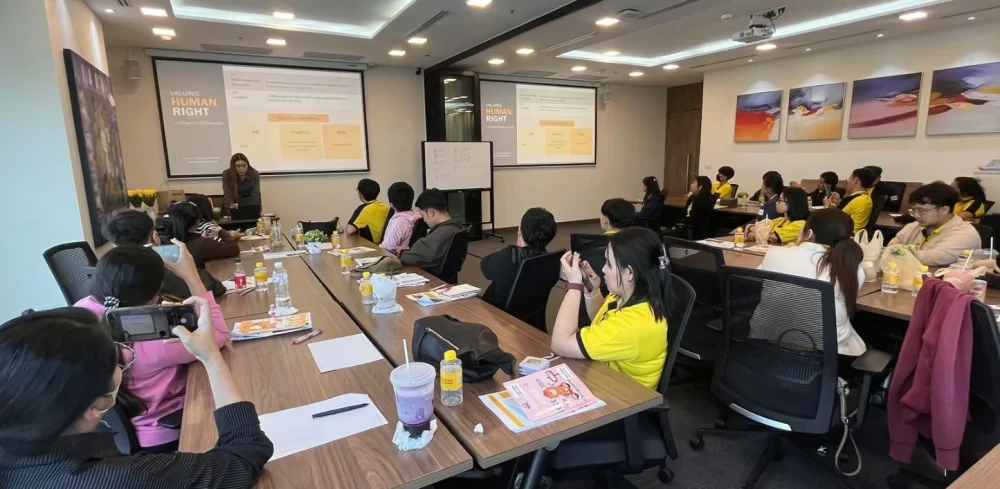
To raise awareness, the Company communicated the policies and practices related to human rights to 100 percent of employees, including key policies such as the Code of Business Ethics, Human Resource Management Policy, and Vendor and Business Partner Code of Conduct. The Company is also developing a standalone Human Rights Policy and has provided specialized training for supervisors to strengthen their capabilities in managing and promoting respect for human rights within the organization.
The Company places importance on human rights and labour standards in response to the expectations and concerns of all stakeholder groups. It regularly listens to opinions and feedback from relevant stakeholders through various channels, such as surveys, site visits, complaints submitted through the grievance channels, and communication with communities and relevant external agencies. The feedback is used to support the ongoing review and improvement of policies, practices, and risk management measures related to human rights and labour standards, as well as to strengthen grievance channels and more effective remediation mechanisms.
In addition, the Company places importance on equitable access to information by preparing and communicating relevant documents, policies, and guidelines in Thai, English, and/or other relevant languages as appropriate, such as Myanmar language. This is to ensure that employees can accurately understand their rights, duties, working conditions, and related channels, reduce the risk of misunderstanding, and promote fair and equal treatment of employees.
Human Rights Due Diligence Approach
The Company is currently developing a systematic Human Rights Due Diligence (HRDD) approach to serve as a framework for identifying, assessing, preventing, mitigating, monitoring, and remediating human rights issues that may be associated with its business operations and value chain. The Company has started considering relevant human rights risk issues for the first time this year and plans to further develop and implement this approach on an ongoing basis.

The Company’s human rights management approach is as follows:
1. Policy Development and Communication
The Company is currently developing a standalone Human Rights and Fair Labour Practices Policy to enhance its human rights management framework, making it clearer, more comprehensive, and aligned with international standards and relevant practices. The policy aims to protect the fundamental rights of all stakeholder groups in a fair and equitable manner and serve as a practical framework for employees, suppliers, business partners, and relevant stakeholders across the value chain.
Once the policy has been approved, the Company plans to disclose and communicate it through various internal and external channels, such as internal announcements, the Company’s website, and other appropriate channels, to promote understanding, implementation, and consistent communication of the policy direction.
2. Human Rights Risk Identification and Assessment
2.1 Identification of Human Rights Risk Issues
The Company is in the process of developing an approach to identify human rights issues that are relevant or may be material to its business operations. This includes considering actual and potential human rights risks across business activities and stakeholders throughout the value chain, including risks where the Company may cause direct impacts, contribute to impacts, or be directly linked to impacts through its activities or value chain relationships.
2.2 Risk Assessment
The Company has established criteria for assessing human rights risks by considering two key dimensions:
- Severity of impact: considering the scale of impact, scope of affected stakeholders, and irremediability, or the ability to restore affected parties to their original condition.
- Likelihood: considering the number or frequency of incidents that may occur.
The results will be used to prioritise salient human rights issues and determine appropriate mitigation and control measures.
3. Remediation, Integrating and Acting
The Company establishes remediation measures for human rights impacts that may arise from its business operations in a manner that is appropriate, fair, and proportionate to the severity of the impact. These measures may include both monetary and non-monetary remedies, such as formal apologies, compensation, restoration of rights or living conditions, improvement of working conditions or relevant practices, corrective actions to prevent recurrence, and disciplinary or legal actions where applicable.
These measures are implemented under a fair, transparent, impartial, and respectful investigation process that protects the dignity of affected persons. The Company also protects complainants, witnesses, and relevant parties from retaliation or discrimination. If a human rights violation is substantiated, the Company will consider disciplinary action in accordance with its internal regulations and/or legal action under applicable laws to ensure accountability and appropriate remedy for affected parties.
4. Grievance and Whistleblowing Channels
The Company provides accessible whistleblowing and grievance mechanisms to enable employees, suppliers, business partners, customers, communities, and relevant stakeholders to raise concerns or complaints related to human rights violations, labour practices, misconduct, or actions that may be inconsistent with laws, the Code of Business Ethics, company policies, and relevant practices. Reports may be made either with disclosure of identity or anonymously.
The mechanism operates based on confidentiality, protection of good-faith whistleblowers from retaliation or discrimination, and an independent, transparent, impartial, and fair complaint-handling process. Stakeholders may report concerns through the following channels:

Direct supervisor
Employees may report to their direct supervisor at manager level or above.

Whistleblowing Unit (Internal Audit Department)

Head of Internal Audit Department

Chairman of the Audit and Risk Management Committee or Independent Director:
By post to:
MR. D.I.Y. Holding (Thailand) Public Company Limited
777 WHA Tower 12th Floor Theparat Road (Bangna–Trad Km 7) Bang Kaeo Sub-district Bang Phli District Samut Prakan 10540 Thailand
The identity of complainants and details of complaints will be kept confidential in accordance with relevant procedures. The Company protects complainants, witnesses, and relevant parties who report in good faith from retaliation, intimidation, demotion, termination, or other forms of unfair treatment. If wrongdoing is substantiated, the Company will consider disciplinary action and/or legal action as appropriate. However, if a complaint is made with malicious intent or false information, the complainant may be subject to action under relevant rules. The process is conducted in accordance with the Company’s Whistleblowing Policy.
5. Monitoring, Review, and Communication
The Company is currently developing a systematic approach to monitor and review the management of human rights risk issues. Performance results and feedback from stakeholders will be used to further improve the Company’s approach where appropriate.
The Company has also communicated and provided training to raise human rights awareness among employees and relevant suppliers through appropriate channels, such as internal training, briefing sessions, emails, posters, and internal communication materials. In addition, the Company provides channels for stakeholders to share feedback, suggestions, and concerns, supporting appropriate reporting or whistleblowing related to human rights violations.
Whistleblower Protection and Remedy
The Company assures non-retaliation against individuals who report concerns in good faith and has established strict measures to maintain confidentiality of information.
In the event that conduct inconsistent with the Company’s policies or applicable laws is identified, the Company will take corrective action and implement appropriate measures based on the severity of each case. These measures may include disciplinary actions or improvements to internal control processes to prevent the recurrence of similar incidents.
If the Company identifies that its operations have caused human rights impacts, it will provide appropriate remedy to affected parties according to the nature and severity of each case. This may include corrective measures, rehabilitation, compensation, or other suitable forms of support to ensure that affected parties receive fair remedy.