
Corporate Governance

Supporting the SDGs Goals


Goals and Performance Highlights
The proportion of female directors to no less than
The proportion of female directors reached
Stakeholders Directly Impacted
Customers
Shareholders
Government Agencies


Commitment, Challenges, and Opportunities
MR. D.I.Y. is committed to conducting business in accordance with the principles of good corporate governance, transparency, and fairness in order to strengthen the confidence of shareholders, investors, and all stakeholder groups.
The Company recognizes that good corporate governance is a key mechanism for driving the organization toward its sustainability goals. The Board of Directors therefore plays an important role in overseeing operations to ensure transparency, accountability, and freedom from corruption. At the same time, board diversity in skills and independence enhances the quality of strategic decision-making and helps build trust among stakeholders.
Strong governance is a key factor in enhancing business efficiency and strengthening the Company’s competitiveness. Through management grounded in transparency, accountability, and business ethics, the Company reinforces confidence and acceptance among all stakeholder groups, supports a credible corporate image, facilitates access to funding, and promotes stable long-term growth.
Management Approach and Value Creation
Corporate Governance Structure
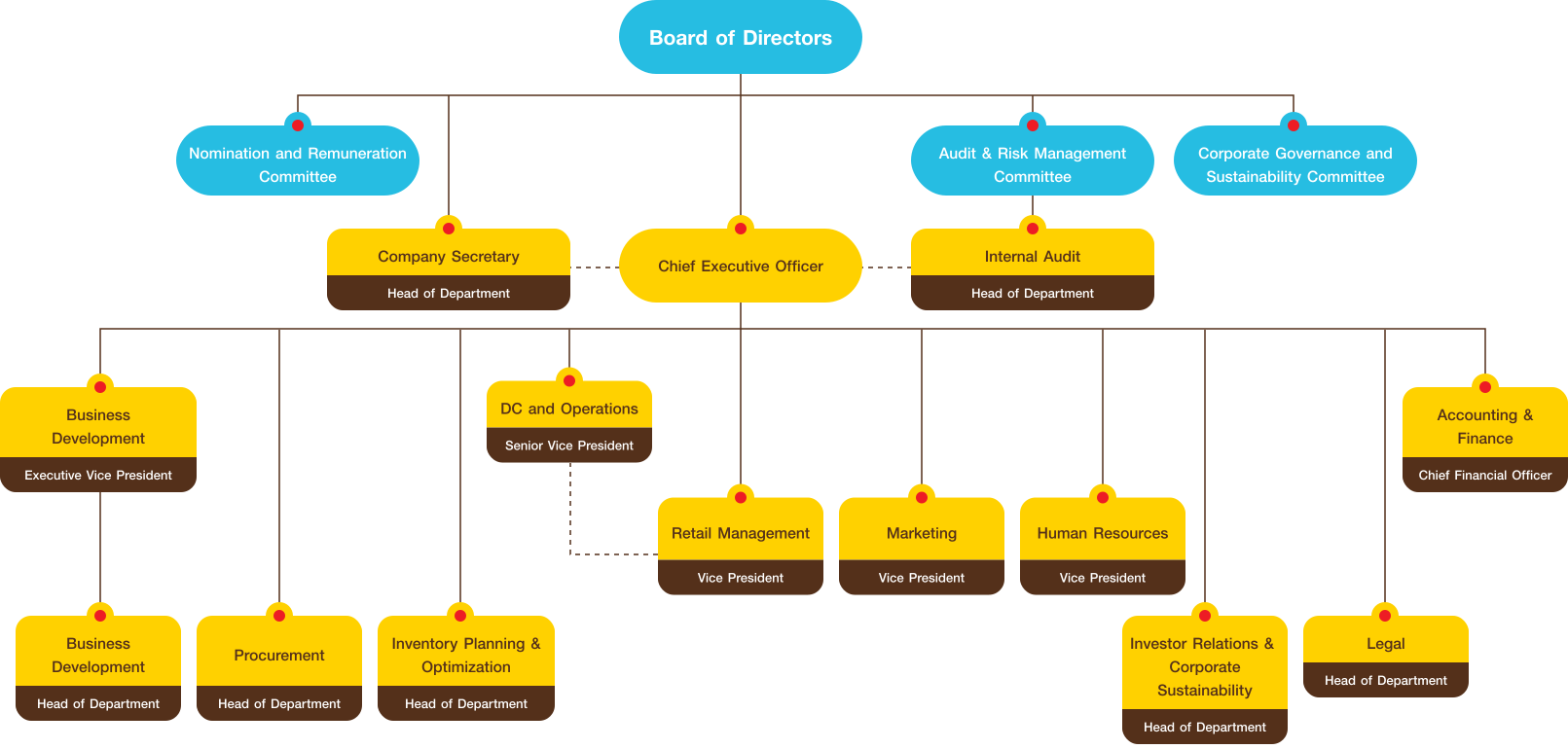
MR. D.I.Y. places great importance on good corporate governance. The Board of Directors is responsible for setting policies and overseeing operations at the corporate level. To support governance in key areas, the Company has established subcommittees, namely the Nomination and Remuneration Committee, the Audit and Risk Management Committee, and the Corporate Governance and Sustainability Committee, to ensure transparent, efficient, and well-governed operations.
- Establishes criteria and processes for the nomination of directors, subcommittee members, and the Chief Executive Officer, while considering diversity in skills, experience, age, and gender to ensure an appropriate board composition.
- Develops remuneration policies and structures for directors, subcommittee members, and senior executives to ensure that compensation is appropriate, fair, and linked to the Company’s performance.
- Evaluates the performance of the Board of Directors, subcommittees, and the Chief Executive Officer against key performance indicators (KPIs).
- Reviews the accuracy, completeness, and reliability of the financial statements to ensure compliance with accounting standards and relevant laws.
- Establishes and reviews the risk management framework and oversees the adequacy of the internal control system.
- Monitors compliance with laws, SEC regulations, SET requirements, and other applicable rules, including reviewing transactions that may involve conflicts of interest.
- Approves the internal audit plan, appoints or removes the Head of Internal Audit, evaluates performance, reviews the independence of the external auditor, and reports key observations to the Board of Directors.
- Reviews goals, policies, and plans relating to environmental, social, and governance (ESG) matters to ensure alignment with the Company’s business operations.
- Monitors and evaluates sustainability performance to ensure the achievement of established targets.
- Oversees governance and sustainability disclosure to ensure that reporting is complete, transparent, and aligned with relevant standards.
- Promotes sustainability awareness among employees at all levels.
Board Structure
The Company operates under a well-structured corporate governance framework with a Board of Directors comprising 7 members, responsible for overseeing the Company’s policies and strategic direction. The Company has clearly separated the roles of Chairman of the Board and Chief Executive Officer in order to promote balance, transparency, and effective checks and balances in management.
In addition, the majority of the Board consists of 4 independent directors, to support independent, transparent, and effective oversight. The board composition is as follows:
Independent directors:
Executive directors:
Non-executive directors:

Board Diversity and Expertise
The Company places importance on Board Diversity, taking into account gender diversity and respect for differences in gender identity, race, nationality, religion, place of origin, ethnicity, age, experience, skills, knowledge, and expertise, while remaining free from bias and discrimination. This supports diversity and gender equality, broadens perspectives, strengthens strategic decision-making, and ensures alignment with an evolving business environment.

Gender Diversity
Male directors:
Female directors:

Age Diversity
35 - 50 years:
51 - 60 years:
Above 65 years:

In addition, the Company uses a Board Skill Matrix as a tool to assess and determine board composition. This takes into account knowledge, capabilities, expertise, and experience relevant to the business, as well as legal requirements, regulatory criteria, and the Company’s strategy, to ensure that the Board has comprehensive capabilities in key areas such as finance, retail business management, and technology. This approach strengthens governance effectiveness and enhances stakeholder confidence, forming an important foundation for the Company’s sustainable growth.
Board Skill Matrix
| Area of Expertise | Number of Directors (Person) | Percentage (%) |
|---|---|---|
| Retail Business | 5 | 71.4 |
| Marketing, Sales, and E-commerce | 5 | 71.4 |
| Real Estate and Project Development | 3 | 42.9 |
| International Trade, Logistics, and Transportation | 3 | 42.9 |
| Manufacturing and Industry | 1 | 14.3 |
| Finance, Economics, and Banking | 5 | 71.4 |
| Accounting | 2 | 28.6 |
| Business Administration and Organizational Management | 7 | 100.0 |
| Investment, Capital Markets, and Securities | 4 | 57.1 |
| Technology, Platforms, and Information Technology | 4 | 57.1 |
| Food and Beverage | 2 | 28.6 |
| Energy | 1 | 14.3 |
| Engineering and Construction | 3 | 42.9 |
Good Corporate Governance and Business Ethics
The Company promotes integrity, transparency, and accountability in the performance of duties by directors, executives, and employees at all levels. It has established a Good Corporate Governance Policy, a Code of Business Ethics, and other related policies as operational guidelines to ensure alignment with governance principles, legal requirements, and stakeholder expectations, while supporting ethical and sustainable business conduct. These policies are reviewed and updated periodically through the Corporate Governance and Sustainability Committee to keep pace with changes in the business environment, laws, and governance standards at both national and international levels.
The Company also communicates these policies to employees at all levels through internal channels, such as new employee orientation and internal communication platforms, in order to foster understanding and embed a culture of transparency and good governance throughout the organization.

Anti-Corruption
The Company is committed to conducting business with integrity, transparency, and accountability, and maintains a zero-tolerance stance against corruption in all forms, whether direct or indirect. The Company has established a written Anti-Corruption Policy as a guideline for directors, executives, and employees at all levels, and requires subsidiaries and affiliates to follow the same approach. The policy is reviewed and updated regularly to ensure alignment with relevant laws, requirements, and standards.
The Company’s risk assessment covers corruption-related issues, including bribery, money laundering, the giving or receiving of gifts, political contributions, facilitation payments, and other forms of corruption, in line with the Company’s policies. In 2025, the Company conducted an enterprise-level risk assessment and determined that the risk of fraud and corruption was at a “medium” level. The Company made no political contributions, with a total amount of THB 0 during the reporting year.

The Company regularly provides training and communication on its anti-corruption policy to employees in order to build knowledge, understanding and awareness of ethical conduct and compliance with relevant laws. The training covers fundamental knowledge of the forms and elements of corruption, including the giving or receiving of bribes, gifts, hospitality, special benefits, conflicts of interest, improper facilitation payments, disclosure or use of confidential information, sexual harassment, and behaviours that may lead to corruption risks, whether direct or indirect. This enables employees to identify risk situations and make appropriate decisions. The training also covers penalties for violations to ensure that employees can effectively apply the principles in their day-to-day work.
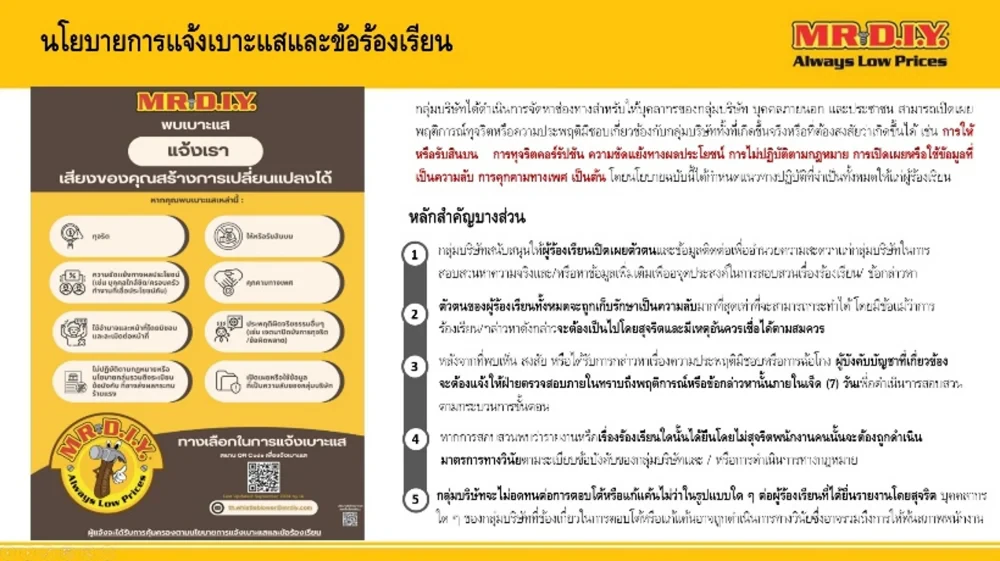
In addition, the Company provides channels for whistleblowing and complaints regarding suspected misconduct or actions inconsistent with the Code of Business Ethics, including bribery, fraud, money laundering, the giving or receiving of gifts, political contributions, facilitation payments, and other corruption-related acts in line with the Company’s policies. Whistleblowers may choose to disclose their identity or remain anonymous. The Company has put in place appropriate and fair protection measures for whistleblowers and affirms that there will be no discrimination or retaliation against anyone who reports concerns in good faith, thereby supporting a transparent and accountable corporate culture.
Whistleblowers may report concerns through the following channels:

Report directly to their supervisor
(manager level or above)


Contact the Head of Internal Audit at

Report to the Chairman of the Audit and Risk Management Committee (Independent Director) or another director by post or email at:
MR. D.I.Y. Holding (Thailand) Public Company Limited
777 WHA Tower, 12th Floor, Thepharat Road (Bangna-Trad Km. 7) Bang Kaeo, Bang Phli, Samut Prakan 10540

Related Documents